In this guide (8 sections)
- 4 section vs 5 section tripod – the short answer
- 5-section tripod vs 4-section – same tripod, one more section
- Why a fifth section costs stiffness
- Height – the fifth section makes it shorter, not taller
- Leg sections, locks and setup speed
- 5-section tripod problems owners run into, and the fix
- Which section count to choose
- Questions photographers ask
We earn a commission if you buy through links on this page, at no extra cost to you. It never changes what we recommend. How we make money.
The short answer
- Pick 4 sections for most shooting: fewer joints, a thicker bottom tube and more height. Pick 5 only when folded length decides whether the tripod comes along at all.
- In Gitzo's Traveler Series 1, the 5-section version folds 7 cm shorter and weighs 25 g less, but stands 9 cm lower with the column down and adds an 11.2 mm bottom tube.
- Both versions carry the same 10 kg rating, so the load spec won't show the thinner leg; owners notice it in wind and on long exposures.
- A fifth section means 12 leg locks to work instead of 9, and it rarely buys height, so tall shooters end up raising the center column.
A 4-section tripod is the better choice for most photographers: fewer joints, a thicker bottom tube and more height. A 5-section tripod makes sense only when its shorter fold decides whether the tripod comes along at all, such as in a carry-on or a small daypack. We’d settle the question with maker numbers, not forum opinion, so this guide uses one tripod family sold in both versions.
4 section vs 5 section tripod – the short answer
The 4 section vs 5 section tripod choice trades packed length against stiffness and height. Every top result we read agrees on the basics. More leg sections fold shorter, fewer sections are steadier, and each extra section adds locks. The Manfrotto buying guide makes the same point one step down: its 055 folds to 54 cm with 4 sections against 63 cm with 3, while the 3-section is “usually said to be more stable.”
What those pages don’t give you is the size of each cost. The rest of this guide measures it.
5-section tripod vs 4-section – same tripod, one more section
Gitzo sells the carbon fiber Gitzo Traveler Series 1 as a 4-section GT1545T and a 5-section GT1555T, which isolates the fifth section. Both use twist locks, two leg angles and the same 10 kg safety payload. Gitzo recommends both for lenses up to 135mm (200mm max).
This table compares the maker’s published specs for the two versions:
| Spec (maker figures) | GT1545T, 4 sections | GT1555T, 5 sections | Difference |
|---|---|---|---|
| Folded length | 42.5 cm (16.7 in) | 35.5 cm (14.0 in) | 7 cm shorter |
| Weight | 1.055 kg (2.33 lb) | 1.03 kg (2.27 lb) | 25 g lighter |
| Max height, column down | 130 cm (51.2 in) | 121 cm (47.6 in) | 9 cm lower |
| Max height, column up | 153 cm (60.2 in) | 138 cm (54.3 in) | 15 cm lower |
| Min height | 22 cm | 20 cm | 2 cm lower |
| Leg tubes | 25.3 to 14.7 mm | 25.3 to 11.2 mm | adds an 11.2 mm tube |
| Safety payload | 10 kg | 10 kg | same |
| Locks per leg | 3 | 4 | one more |
Sources: GT1545T spec page and GT1555T spec page.
From our notes: When we lined up Gitzo’s two Traveler spec pages, we expected the 5-section version to be clearly lighter, since that is the usual travel pitch. It isn’t: the gap is 25 g, about the weight of a spare battery. The real differences sat in two other rows. The 5-section legs end in an 11.2 mm tube the 4-section never uses, and the whole tripod stands 9 cm lower with its column down. So the fifth section buys 7 cm of packed length and pays in stiffness and height, not grams.
Why a fifth section costs stiffness
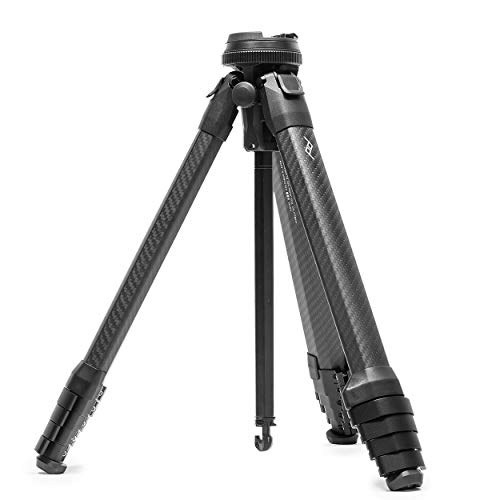
The fifth section adds the thinnest telescoping tube and one more joint, and a leg is only as stiff as its weakest part. In the Gitzo pair, the 4-section’s bottom tube is 14.7 mm across. The 5-section adds one at 11.2 mm. A Rokslide poster comparing two Manfrotto 190 versions saw the same pattern one step down: the 4-section’s last tube measured about 0.46 in against roughly 0.68 in.
Owners describe the result consistently. In a Fred Miranda thread, one shooter ranks his 5-section Peak Design as the least stable of his three tripods. He keeps it for when “compact size is THE criterion,” and calls a good 4-section “very nearly as good” as a 3-section. A DPReview owner of FLM’s CP30 range wrote that the five-section model “is least stiffest” of the series.
The rated load won’t warn you
Both Gitzo versions carry the same 10 kg rating, so the load capacity hides the thinner leg. We read a rating as “won’t fail,” not “won’t vibrate.” A mirrorless body with a 24-70mm sits far below 10 kg on either. The gap shows up in wind, on long exposure shots and with a long lens, where the thin bottom tube picks up vibration first.
Height – the fifth section makes it shorter, not taller
Extra leg sections usually buy a shorter fold, not a taller tripod. The Pictureline guide says “the more sections, the taller the tripod at maximum height.” The maker data says otherwise: the 5-section Gitzo stops at 121 cm with the column down, 9 cm lower than the 4-section’s 130 cm. A DPReview owner of a 5-section Sirui put it plainly: section count doesn’t set the height. “But it does affect how long/short when folded.”
Column-down height is your real working height. At 121 cm plus a head, the viewfinder sits well below standing eye level for most adults. Our guide on how tall a tripod should be for your height works it out step by step.
Extra section vs center column
That was the original question in the top-ranking DPReview thread. Is a 5-section leg steadier than a 4-section leg plus the column at the same height? Owners there and on Fred Miranda rate the raised column as the bigger loss. So we’d buy enough leg height to skip the column, and treat the section count as second.
Leg sections, locks and setup speed
Leg sections set the lock count: a 4-section tripod has 9 leg locks, a 5-section tripod has 12. TheDigitalProcess makes the point with 6 against 12 locks: when you race the light, each extra lock adds up. The same guide prefers lever locks, because you can see at a glance whether each one is open.
Setup order matters more than lock style:
- Extend the thickest top sections first and the thinnest bottom section last.
- Leave the last section partly collapsed if you don’t need the height.
- Raise the center column only after every leg section is out.
5-section tripod problems owners run into, and the fix
Most complaints about 5-section legs come down to wobble on long exposures, a tripod that’s too short, and locks that loosen.
Wobbly for long exposures
A recurring point in DPReview travel-tripod threads: a small travel tripod feels too wobbly once ND filters, astro or a 100-400mm join the kit. One long-exposure shooter wrote: “For long time exposures and astro I would not buy a tripod with more than 3 leg locks” (thread). Another, in the lightest tripod for hiking thread, was blunter: “I would stay away from 5 section legs.” If you already own 5-section legs, leave the bottom section in, hang your backpack low and fire with a 2-second timer. Our fixes for tripod shake in wind cover the rest.
Too short, so you bend over
The same hiking thread notes that “a travel pod will be shorter requiring you to bend over to look through the VF.” It adds: “I avoid using the center post when possible but in a travel pod thats even more important.” Check column-down height plus your head before you buy. In the Gitzo pair, the 4-section stands 9 cm taller without touching the column.
Locks that loosen or break
More sections mean more joints to service. One owner in an r/RealEstatePhotography thread found a leg joint stopped holding because its old grease had hardened. The hiking-thread advice is to look for “metal locks vs plastic flip locks.” Rinse the legs in fresh water after sand or salt, and service the locks with the maker’s grease; Gitzo sells maintenance kits.
Which section count to choose
Choose 4 sections unless the folded length is what keeps the tripod out of your bag.
- Carry-on or small daypack: 5 sections, if the 4-section won’t fit. A Fred Miranda poster notes a 4-section fits the overhead bin more easily than a 3-section. Compare our tripods that fit in carry-on luggage.
- Hiking, landscape, long exposure or astro: 4 sections, column down. See our hiking tripods by pack weight.
- Tall photographers: 4 sections with a high column-down height.
- Already own 5 sections: keep the bottom tube in when you can.
Weighing two real tripods on exactly this trade? Our comparison of a 5-section Peak Design against the 4-section Befree Advanced is the next read.
Questions photographers ask
Are 5 section tripods less stable?
Usually, yes. The fifth section is the thinnest tube on the leg and adds one more joint, so a 5-section tripod flexes more at full extension than a 4-section model of the same build. A well-made 5-section tripod is still steady for a mirrorless body and a standard zoom.
How many leg sections should a travel tripod have?
Four suits most travel. Choose five only when the shorter folded length decides whether the tripod fits your carry-on or daypack; otherwise the extra section costs stiffness, height and setup time.
Is a 5-section tripod taller than a 4-section tripod?
Not necessarily. Section count mainly sets folded length. In Gitzo's Traveler Series 1 the 5-section version reaches 138 cm against 153 cm for the 4-section version.
Is an extra leg section better than raising the center column?
Owners in DPReview and Fred Miranda threads rate a raised center column as the bigger stability loss. If you need the height, extending the legs fully beats cranking up the column.
Does a 5-section tripod take longer to set up?
Yes, a little. Each leg has four locks instead of three, so a full setup means 12 locks instead of 9, plus one more tube to extend on every leg.
Why you can trust this guide
- Products are checked against manufacturer specifications, user manuals and long-term owner reports.
- Each pick is scored on the Best Tripod Score: stability, portability (weight and folded length), working height, build quality and value. Scores come from published specs and owner reports, not hands-on testing.
- We never accept payment for placement. Affiliate commissions do not affect rankings.
Last reviewed . Read our research process and editorial policy, or report an error.
Sources
- Gitzo Traveler Series 1, 4 sections (GT1545T)
- Gitzo Traveler Series 1, 5 sections (GT1555T)
- Tripod Buying Guide (Manfrotto)
- Choosing a Tripod and other Supports (TheDigitalProcess)
- Choosing the Right Tripod (Pictureline)
- Travel tripod, 5 section leg or 4 section leg + center column (DPReview forums)
- 4-section long tripod vs 3-section tripod (Fred Miranda forums)
- Lightest tripod for hiking? (DPReview forums)
- Tripod for travel, hiking and long exposure (DPReview forums)
- 3 section vs 4 section, packability and stability (Rokslide)

Best Tripod Editorial Team
Research & editorial
We research tripods, monopods and heads for photographers and video creators: real working height with and without the center column, load capacity against the gear you actually shoot, packed length for a carry-on, leg-lock speed and Arca-Swiss compatibility. Every guide follows our published research process and editorial policy.