In this guide (9 sections)
- Our top picks
- Are Cheap Gimbal Heads Any Good? The Short Answer
- What a Cheap Gimbal Head Gives Up
- Rated Load vs Your Real Lens
- Two Budget Gimbal Heads the Ranking Guides Agree On
- Cheap Gimbal Head vs Wimberley: When to Pay More
- Problems Owners Run Into With Budget Gimbals, and the Fix
- Our Verdict on Cheap Gimbal Heads
- Questions photographers ask
We earn a commission if you buy through links on this page, at no extra cost to you. It never changes what we recommend. How we make money.
How we picked these
- 7 owner posts, user discussions and expert reviews read across 6 sources.
- Every spec checked against 12 maker and retailer pages.
- We did not test these products ourselves, and we say so. All sources are linked at the end of this guide.
Our top picks
 Best budget full gimbal · 3.3/5Oben GH-30 Gimbal Head
 Best step-up carbon gimbal · 3.8/5Sirui PH-20 Gimbal Head
The short answer
- Yes, with limits. A cheap gimbal head holds a 150-600mm or 200-500mm zoom and lets you find out whether you will use a gimbal at all.
- What you give up is smoothness and precision: owners report plastic bushings, sticky grease, stiff or rough motion and framing that shifts when you lock the knobs.
- The Oben GH-30 (budget, aluminum) and the Sirui PH-20 (carbon, converts to side mount) are the two lower-cost heads that several ranking guides recommend.
- Pay for a Wimberley-class head if you shoot a 500mm or 600mm f/4 prime for long sessions or track birds in flight from a tripod every week.
Picture the moment: a new 150-600mm zoom on the desk, a heron that stands still for forty minutes, and premium gimbal heads priced like another lens. So, are cheap gimbal heads any good? Yes, for a 150-600mm or 200-500mm zoom and occasional use, as long as you accept stiffer, less refined motion. A cheap gimbal head is also the lowest-risk way to learn whether you will use a gimbal at all. We would step up to a premium head only for a 500mm or 600mm f/4 prime used for long sessions, or for daily tracking of birds in flight.
Are Cheap Gimbal Heads Any Good? The Short Answer
A cheap gimbal head does the core job: it holds a telephoto lens at its balance point so the rig feels weightless and stays where you leave it. What you lose is smoothness, precision and some trust in the locks.

A gimbal head clamps the lens foot, not the camera, and pivots the lens around its center of gravity. The ranking guides agree on that part, and most add one more point: a gimbal head is not a motorized video gimbal.
The forum owners split in a useful way. On DPReview, one owner wrote, “I would steer well clear of cheap gimbals. You are looking for solid construction and very smooth bearings.” Another in the same 180-600 thread answered, “These inexpensive gimbals are perfectly adequate for determining whether or not he’ll use one.” We think both are right, for different shooters.
What a Cheap Gimbal Head Gives Up
A budget gimbal saves money in the parts that move: bushings instead of bearings, thick grease instead of tuned friction, and simpler locks and clamps.

The roundups touch on it only briefly (Digital Camera World notes that cheaper gimbals can add slack and wobble), but the owner threads we read go into detail.
Bushings, grease and stiffness
On generic Beike-type heads, owners describe nylon or plastic bushings where premium heads use bearings. A Nikonites owner put it plainly: “i think the main area of cheapness is nylon bushes instead of bearings.” A DPReview owner with a Beike found the bush had “a mixture of play and stiffness” and fitted ball races on a lathe. Another, with a budget Neewer head, removed the factory grease, regreased it with white lithium grease and said it then worked very well.
The stiffness is not all bad. A Talk Photography owner found a Beike BK-45 fine for static birds and video, but too stiff for birds in flight. A reply in that thread warns that some plastic bushings swell when lubricated, so check the grease first.
Lock shift and clamp quality
Lock shift means the framing moves when you tighten a knob. One Talk Photography owner returned a BK-45 because the locks moved the head considerably and the Arca-Swiss clamp felt crude. Mid-priced heads are not immune: Shutter Muse saw a diagonal shift when tightening the Sirui PH-20 tilt knob. Lock shift matters for static compositions and panoramas, so we would check it at home first. It matters little when you track with the knobs loose.
Weight and bulk
Budget aluminum gimbals are heavy. The Oben GH-30 weighs 3.15 lb per its manual, the same figure Backcountry Journeys lists for a Wimberley WH-200. A DPReview owner noted that gimbals are “relatively large and heavy to transport, even those that break down into three separate parts.” If weight is your limit, look at side mount designs: Shutter Muse measured the Sirui PH-20 23% lighter in side mount mode.
Rated Load vs Your Real Lens
A cheap gimbal head’s load rating says what it can hold, not how smoothly it moves at that weight. Most budget heads are rated far above a zoom rig, so the rating is rarely the problem.

Oben rates the GH-30 for 44 lb (20 kg). One Nikonites owner put a 200-500mm plus a D610 at about 7 pounds, and a Backcountry Gallery owner gave 11.25 lb for a 600mm f/4G VR. Both sit well under 44 lb. Yet Shutter Muse warns not to take the GH-30 rating at face value: it loses smoothness with very heavy setups, and he calls it OK with lighter lenses such as a 70-200mm, 100-400mm, 200-600mm or Nikon Z 400mm f/4.5.
For us, the rule is simple: size a gimbal for smooth motion with your heaviest lens, not for the number on the box. Keep the camera-and-lens weight well under the rating, and never load any head beyond it.
Zoom lenses add a catch. A DPReview owner found his 200-500mm tipped slightly at the long end because the barrel extends. That happens on any gimbal, cheap or premium, so balance at the focal length you use most.
Two Budget Gimbal Heads the Ranking Guides Agree On
These two lower-cost heads are each recommended by at least two of the pages that rank for this question, and each has its own Amazon listing.

We chose from the products the top results recommend, then checked specs against the manual or B&H and read owner threads. We have not used either head ourselves.
Oben GH-30 Gimbal Head: Best budget full gimbal
3.3Best Tripod Spec Score out of 5
- Stability7/10
- Portability (weight and folded length)5/10
- Build (materials, leg locks, head)6/10
- Value9/10
A real cradle gimbal with a high rating for little money; heavy, and its motion is less refined than premium heads.
What owners and reviewers say from 3 reviews and posts we read
Praised for
- Smooth enough with a slight drag and no wobble
- Balances and holds a Z9 with a 600mm TC rig
- Oben replaced a faulty unit even out of warranty
Common complaints
- Movement can be stiff or a bit rough
- Grease leaked from the panning base on one owner's head
- Heavy for a head (about 3.2 lb)
Read on: Fred Miranda: Oben GH-30 problem, help appreciated · Backcountry Gallery forums: Gimbal head (page 2) · r/Nikon: OBEN GH-30 Gimbal
Who it's for: Wildlife shooters with a 100-400mm, 150-600mm or 200-600mm zoom who want a full gimbal for weekend use; Shutter Muse says it loses smoothness with very heavy setups, and at 3.15 lb it is not light.
Shutter Muse, Backcountry Journeys and B&H eXplora all name the Oben GH-30 Gimbal Head as the affordable full gimbal. Its curved aluminum arm carries a plate platform you slide up and down, so you can line the lens center up with the tilt axis for true balance. Oben’s manual lists 44 lb (20 kg), 3.15 lb, a 360° panning base, a 3/8” socket and an Arca-type plate with two 1/4” screws plus 3/8” bushings. Owners are mixed but mostly content. A Backcountry Gallery owner says it balances his Nikon 600mm TC rig fine, though the movement is “a bit rough.” A Fred Miranda owner found the head stiff and then leaking grease after a couple of years; Oben replaced it with a new, smoother unit. Shutter Muse calls it a good option for the odd weekend excursion.
Sirui PH-20 Gimbal Head: Best step-up carbon gimbal
3.8Best Tripod Spec Score out of 5
- Stability8/10
- Portability (weight and folded length)7/10
- Build (materials, leg locks, head)7/10
- Value8/10
Smooth carbon gimbal with a side mount option at a mid price; lock shift and quality-control slips keep it below premium heads.
What owners and reviewers say from 4 reviews and posts we read
Praised for
- Beautifully made and well built
- Effortless panning, used for hours with a 180-600mm
- The included side mount option
Common complaints
- The pan lock shifts the framing when tightened
- Knobs did not stop a 500mm f/4 rig moving when carried; one owner sent it back twice
Read on: DPReview forums: Any experience with the Sirui PH-20? · Backcountry Gallery forums: Gimbal advice (page 3) · Shutter Muse: Sirui PH-20 review, reader comments
Who it's for: Shooters who want smoother motion and less weight than the cheapest heads without paying premium prices; owners report the locks can shift your framing when tightened.
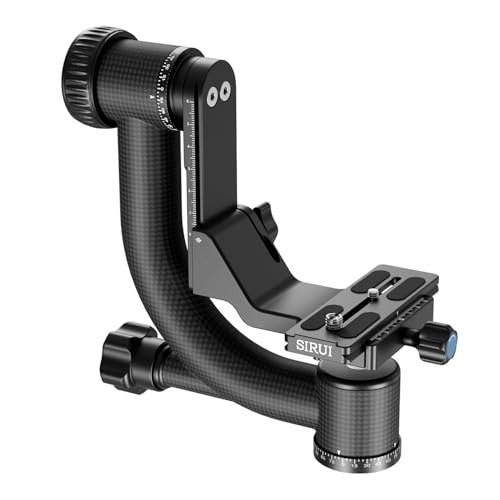
If you can stretch past the cheapest tier, the Sirui PH-20 Gimbal Head buys smoother motion and a lighter build. Its arm is carbon fiber, and B&H lists 44.1 lb (20 kg), 2.4 lb and a 120 mm Arca-type plate. Shutter Muse measured 1,163 g with the cradle and 899 g after swapping in the included side mount clamp. He found the pan and tilt silky smooth, but also a 2-3° scale misalignment and a framing shift when tightening the tilt knob. Owners echo both sides. A Backcountry Gallery owner used it for hours in Costa Rica with a 180-600mm, while a DPReview buyer found the pan lock moved the framing. One Shutter Muse reader sent his back twice because the knobs would not stop a 500mm f/4 rig from moving when carried.
From our notes: When we lined up the Oben manual, the Sirui spec sheet and three forum threads about generic gimbals, the pattern surprised us. The load ratings barely differed: 44 lb for the Oben and the Sirui. What differed was everything the spec sheet leaves out. Owners of the cheapest heads wrote about plastic bushings, sticky grease and locks that nudge the framing. Shutter Muse and owners wrote about the PH-20’s smooth bearings but also its tilt-lock shift. So we stopped comparing ratings and started asking one question: how will the head be used?
Cheap Gimbal Head vs Wimberley: When to Pay More
Pay for a premium gimbal head when the lens is a big prime, the sessions are long and tracking smoothness decides the shot. For a zoom and occasional outings, a budget gimbal is enough.
The table below compares the three tiers on the points owners and guides raise most.
| Tier | Example | Rated load | Motion, per owners and reviews | Best for |
|---|---|---|---|---|
| Generic cheap gimbal | Beike BK-45 type | Varies by listing | Stiff, plastic bushings; regreasing helps | Hides, static subjects, trying a gimbal |
| Budget brand | Oben GH-30 | 44 lb (20 kg) | Smooth enough, can feel rough | 150-600mm zooms, weekend use |
| Mid-priced carbon | Sirui PH-20 | 44.1 lb (20 kg) | Silky smooth, lock shift reported | Lighter kit, frequent use |
| Premium | Wimberley WH-200 | Over 100 lb, per B&H | The benchmark for smoothness | 500-600mm f/4 primes, daily use |
Choose a budget gimbal if:
- You shoot a 150-600mm, 180-600mm or 200-500mm zoom a few times a year.
- You mostly wait on one subject, at a nest, a feeder or a hide.
- You want to learn whether a gimbal suits you before spending more.
Choose a premium head if you track birds in flight from a tripod every week, or if you shoot a 500mm or 600mm f/4 prime for hours at a time. Talk Photography’s owners put it simply: cheap heads “do the job but without any finesse.”
Problems Owners Run Into With Budget Gimbals, and the Fix
The common problems are a gimbal that goes unused, a head too heavy to carry and legs too light for the lens. Each has a fix that costs little.
- The gimbal stays home. A DPReview owner with a 200-500mm wrote, “I have used it less than I anticipated,” thanks to VR and IBIS. The fix is a cheap head first, or a monopod. Our monopods with feet for wildlife suit a 180-600mm on the move.
- It is too heavy to hike with. Carry the gimbal only when you plan a long sit, and use a ball head the rest of the time. Gimbal adapters that mount on a ball head need a strong one, and one DPReview owner found a Wimberley Sidekick unusable on his Sirui K-30x ball head. Our ball head tripod guide covers sizing a ball head by lens weight.
- The legs shake. Digital Camera World compares a gimbal on a cheap travel tripod to a fine lock on a flimsy door. Keep the center column down and choose legs rated well above the rig; our guide to the tripod for wildlife photography explains which legs hold a long lens steady.
- The plate slides or the lens won’t balance. Use a long Arca-Swiss plate on the lens foot, and check that your plate fits the clamp. Our explainer on Arca-Swiss plates and clamps shows why some plates fit loosely.
Our Verdict on Cheap Gimbal Heads
For that heron and a 150-600mm zoom, a cheap gimbal head is good enough. We would start with the Oben GH-30, or the Sirui PH-20 if lighter weight and smoother motion matter.
With a stiff generic head, we would regrease it first, then balance at the focal length we use most. Lock the knobs only when you leave the rig. If the gimbal becomes a weekly habit with a big prime, that is the time to buy a Wimberley-class head. The next question is usually the legs: start with our tripod for wildlife photography guide, and browse more tripod heads when you are ready.
Questions photographers ask
Is a cheap gimbal head good enough for a 600mm lens?
For a 150-600mm or 200-600mm zoom, usually yes. For a 600mm f/4 prime it depends on the head: Shutter Muse says the Oben GH-30 loses smoothness with very heavy setups and suggests stepping up to a head like the Sirui PH-20 for bigger lenses, even though both are rated for 44 lb.
What is the difference between a cheap gimbal and a Wimberley?
Mostly the moving parts and the finish. Owners of generic budget gimbals report plastic bushings and sticky grease instead of bearings, which makes the motion stiffer, and cruder locks and clamps. Premium heads such as the Wimberley WH-200 move more freely, hold position more precisely and carry more weight.
Can you make a cheap gimbal head smoother?
Owners often do. DPReview owners describe removing the thick factory grease and regreasing the pivots, and one fitted ball races on a lathe. Check that the grease suits plastic parts first, since one owner warned that some bushings swell when lubricated.
Do I need a gimbal head for a 180-600mm lens?
Not always. DPReview owners with 200-500mm zooms and newer Z telephotos say stabilization lets them handhold more than they expected, and a 180-600mm owner there prefers a monopod. A gimbal pays off on long waits at a nest, a hide or a shoreline, where holding the lens for an hour is not realistic.
What is the best affordable gimbal head?
Among lower-cost heads, the Oben GH-30 is the one Shutter Muse, Backcountry Journeys and B&H eXplora all recommend, and the Sirui PH-20 is the mid-priced step up that Shutter Muse and Backcountry Journeys recommend.
Why you can trust this guide
- Products are checked against manufacturer specifications, user manuals and long-term owner reports.
- Each pick is scored on the Best Tripod Score: stability, portability (weight and folded length), working height, build quality and value. Scores come from published specs and owner reports, not hands-on testing.
- We never accept payment for placement. Affiliate commissions do not affect rankings.
Last reviewed . Read our research process and editorial policy, or report an error.
Sources
- Oben GH-30/30C gimbal head manual (specifications)
- B&H: Oben GH-30 Gimbal Head specs
- B&H: Sirui PH-20 Gimbal Head specs
- Shutter Muse: The Best Gimbal Tripod Heads
- Shutter Muse: Sirui PH-20 Gimbal Head Review
- B&H eXplora: Gimbal Heads, and How to Choose One
- Backcountry Journeys: 10 Best Gimbal Heads for Wildlife Photography
- Digital Camera World: The best gimbal heads for tripods
- DPReview forums: Cheap Gimbal Heads
- DPReview forums: Gimbals for 180-600 and wildlife
- Talk Photography: Cheap Gimbal Head
- Nikonites: Inexpensive Gimbal Head
Reviews and discussions we read

Best Tripod Editorial Team
Research & editorial
We research tripods, monopods and heads for photographers and video creators: real working height with and without the center column, load capacity against the gear you actually shoot, packed length for a carry-on, leg-lock speed and Arca-Swiss compatibility. Every guide follows our published research process and editorial policy.